SEARCH

Custom Search
Showing posts with label tax. Show all posts
Showing posts with label tax. Show all posts
Tuesday, March 27, 2012


Monday, March 26, 2012
Tuesday, March 13, 2012
Ron Paul Wins First Caucus: MSM Changes Rules, Reports Romney Wins

Republican presidential candidate Ron Paul secured his first caucus victory over the weekend, by winning 29 percent of the popular vote among the people of the U.S. Virgin Islands. However, the mainstream media decided to report that despite coming in second with 26 percent, Mitt Romney was the real winner.
The Republican Party of the U.S. Virgin Islands reported the results as “112 to Paul (29%), 101 to Romney (26%), 23 to Santorum (6%), 18 to Gingrich (5%),”
In response, The AP and other mainstream reports yesterday claimed that Mitt Romney won caucus, because he stands to come away with more delegates.
Ron Paul supporters and the campaign itself have been tirelessly pointing out that in many of the states that have already held primaries and caucuses, the amount of delegates the Congressman has secured does not always reflect his positioning in the straw polls. Indeed, in Iowa and New Hampshire Paul secured as many delegates as Romney and Santorum.
Yet the media has always reported the winner as the candidate who won the highest percentage in the popular vote.
Not so this time around. When Ron Paul secures a caucus victory, the media changes the rules and declares it is the delegate count that determines the real winner.
“The media is reporting that Mitt Romney won the U.S. Virgin Island Caucus when Ron Paul actually won the popular vote,” wrote the Paul campaign team in an email to supporters.
“If the popular vote means you’ve won, then Ron Paul just won the U.S. Virgin Island Caucus. If collecting delegates equals victory, then Paul stands to do well there too.” the Paul campaign added.
“The media is trying to have it both ways with Romney and the Virgin Island Caucus while ignoring Ron Paul’s actual straw poll first place victory,”
Paul’s official campaign blogger Jack Hunter explains how the media changed the rules below:
Romney stands to win more delegates because, like some US states, The Virgin Islands directly elect delegates in a process that is separate from the caucuses. The six delegates with the most support get to go to the national convention.
As such, Romney won three delegates plus three more via RNC member pledges. He also picked up a uncommitted delegate after the balloting, to bring his total delegates to seven. Ron Paul will take one delegate.
However, the facts show that Ron Paul unquestionably “won” the U.S. Virgin Island Caucus, in the same way Santorum “won” Iowa, Romney “won” New Hampshire, and Gingrich “won” South Carolina.
Portions of the mainstream media know this is the case, and have blatantly ignored it, simply because they do not wish to see Paul, the only anti-establishment candidate, doing well in the race.
The next states to hold primary elections are Mississippi and Alabama. Caucuses will also be held in Hawaii and the American Samoa this Tuesday.
—————————————————————-
Steve Watson is the London based writer and editor for Alex Jones’ Infowars.net, and Prisonplanet.com. He has a Masters Degree in International Relations from the School of Politics at The University of Nottingham in England.
Thursday, March 1, 2012
Valley News: Stockton's Bankruptcy Unlikely to Stop any Cuts
Valley News: Stockton's Bankruptcy Unlikely to Stop any Cuts: By John Rudolf Stockton, Calif., took a major step toward becoming the largest U.S. city ever to file for bankruptcy with a city counc...
Tuesday, February 28, 2012
All Delegates Belong to Ron Paul
No Other candidate has been awarded any delegates, but Ron Paul. Don't believe what they are telling you!
Monday, February 27, 2012
Ron Paul Supporters look to convention

They are full-throated and full-throttle for the Texas congressman and Republican presidential hopeful.
Paul’s fans here are easy to spot and plan to stay busy through Super Tuesday. Though many aren’t traditionally associated with the Republican Party, their activities are common: sign waving in Cherokee and DeKalb counties, a rally in Marietta, a potluck dinner in Gwinnett. In cyberspace, Paul’s following is legion, and from Facebook and Twitter to Meetup.com, his supporters are voracious in their championing of the candidate.
Their attraction to the libertarian-leaning Paul is varied. Some love his record as a strict fiscal conservative who eschews tax increases and fights to lower the national debt. Others are drawn to his interest in moving the country’s currency back to the gold standard and still others love his foreign policy, which is centered around a withdrawal of most U.S. troops from around the world.
The same enthusiasm for Paul was there in 2008, when Paul also ran for president, yet he finished a distant fourth in the Georgia primary. This year, he again trails — polls show him in single digits — in the race for Georgia’s March 6 primary, but his supporters hope their influence in the state won’t end March 6.
Paul has a plan to remain relevant through the Republican National Convention this summer in Tampa. The blueprint goes beyond the primary to the GOP state convention in May, when Paul supporters will try to get themselves elected delegates to the national convention. If that happens, they could try to crash the party and force a floor fight for the GOP nomination.
In a strategy that’s being employed in other states, too, Paul’s Georgia supporters lay out the idea right on their website: “Take back the GOP from the ne’re-do-wells by becoming a Georgia GOP Delegate!” the site implores, complete with instructions on how to navigate the party’s rules.
Christopher Wall, a Johns Creek firefighter, is a Paul supporter seeking a ticket to Tampa.
“I’ll go as far as I can,” he said.
Wall, who will be a delegate to his county convention, said if the nomination comes down to a fight at the convention, anything can happen.
“It’s likely we’ll have a brokered convention,” he said.
Georgia’s Paul-backers are not alone. Paul has not campaigned in Georgia and is not expected to. Instead, he has focused on states that are awarding their delegates through caucuses, rather than primaries, because they are a higher payout for candidates who rely on grass-roots support.
To finish Reading this Article, Click Here!
Friday, February 24, 2012
O'REILLY: It was mutual destruction. Now you can handle any weaponry or any kind of thing to surrogates, who will do your killing for you. Look, if you don't think Iran is sponsoring terrorism, you're living in the land of Oz, congressman.
PAUL: Well, so is Saudi Arabia. What are you going to do about Saudi? What are you going to do with Pakistan?
O'REILLY: It's not a government policy in Saudi Arabia. It's just a failure to do any effective policing. It's a policy in Iran to wipe out Israel...
PAUL: It's our policy...
O'REILLY: ...to attack USA.
PAUL: It's our policy of preemptive, deliberate invasions of foreign countries and occupying these countries that has jeopardized our safety. This blowback principle is what caused 9/11. And we have to come to realize it. If you keep living in this dream land of saying that they attack because we're free and prosperous, believe me, we're never going to get free from fear ...
Read more: http://www.foxnews.com/story/0,2933,296404,00.html#ixzz1nHpryeq4
PAUL: Well, so is Saudi Arabia. What are you going to do about Saudi? What are you going to do with Pakistan?
O'REILLY: It's not a government policy in Saudi Arabia. It's just a failure to do any effective policing. It's a policy in Iran to wipe out Israel...
PAUL: It's our policy...
O'REILLY: ...to attack USA.
PAUL: It's our policy of preemptive, deliberate invasions of foreign countries and occupying these countries that has jeopardized our safety. This blowback principle is what caused 9/11. And we have to come to realize it. If you keep living in this dream land of saying that they attack because we're free and prosperous, believe me, we're never going to get free from fear ...
Read more: http://www.foxnews.com/story/0,2933,296404,00.html#ixzz1nHpryeq4
Thursday, February 23, 2012
Keen on slashing the national debt? Ron Paul is your man
Ron Paul ranks as the one candidate among four whose announced policies would leave America with a lower national debt than it would have under a status quo course, according to a new analysis.
By Mark Trumbull | Christian Science Monitor – 2 hrs 20 mins ago
Ron Paul has touted himself as the strongest fiscal conservative running for the Republican presidential nomination, and according to one new analysis, he may be right.
The Texas congressman ranks as the one candidate among four whose announced policies would leave America with a lower national debt than it would have under a status quo course.
That's the tentative conclusion of the Committee for a Responsible Federal Budget (CRFB), a nonpartisan fiscal watchdog group, in a report evaluating the tax and spending policies of Representative Paul, Newt Gingrich, Mitt Romney, and Rick Santorum.
It's some basic math that any cash-strapped household would understand: His cuts to federal spending would outweigh his proposed tax cuts. The other candidates so far haven't fleshed out spending-cut plans that equal or exceed their tax cuts, which reduce expected federal revenues. In all, Paul's proposals would leave the United States with a national debt equaling 76 percent of one year's gross domestic product in 2021. That would be slightly higher than the debt is today, but lower than it would be in a base-line scenario that represents current policies pursued by Congress.
Former Massachusetts Governor Romney would leave public debt at 86 percent of GDP in 2021. Former US Senator Santorum would leave debt at 104 percent of GDP. Former House Speaker Gingrich would leave it at 114 percent of GDP.
In the base-line case, debt reaches 85 percent of GDP. This assumes a continuation of Bush-era tax cuts, an ongoing "patch" to keep more Americans from being hit by the alternative minimum tax, and an annual "doc fix" for physician payments under Medicare. In this status quo scenario, the deficit would amount to more than $1 trillion in 2021.
In public opinion polls, Americans see reducing annual deficits and the nation's overall debt as a top priority (behind economic growth and job creation) for government. Many economists say the debt is already rising into a zone that could threaten the economy's stability. Paul's prescription is to tackle the problem in libertarian fashion, with a major downsizing of the federal government. His proposals, as gauged by CRFB, would reduce federal spending by some $7.5 trillion over a nine-year period. (For comparison, federal spending will total $3.6 trillion in the 2012 fiscal year, the Congressional Budget Office estimates.)
Paul's cuts would span from the military to Medicaid and beyond.
In one TV ad, Paul's campaign has shown pictures depicting the Departments of Education, Interior, Energy, Commerce, and Housing and Urban Development blowing up as federal spending is reined in. "Later, bureaucrats," the narrator says.
His plan also calls for significant reductions in taxes on personal income, estates, and corporate income – totaling $5.2 trillion over the nine-year period that CRFB analyzed.
The CRFB analysis is tentative for several reasons. The group highlights estimates from an "intermediate scenario" for each candidate, based on policies each has spelled out in some detail. Romney doesn't get credit, for example, for his currently vague call for capping federal spending at 20 percent of GDP.
The CRFB says it will update its report as candidates revise or flesh out their economic plans.
The report also shows an alternative "low-debt" scenario, which essentially takes candidate pledges at face value, even if the proposals currently lack in detail.
In this scenario, Paul also leads the Republican pack in fiscal discipline, with debt falling to 67 percent of GDP. Romney and Santorum (who has a goal to cut $5 trillion in federal spending in five years) would also leave the US with lower debt than under the status quo case. Another caveat to the CRFB analysis: Paul's proposal to end the Federal Reserve would have wide and uncertain impacts on the economy. The CRFB takes only a first glance at this issue. It emphasizes an "intermediate-debt" scenario in which shutting down the Fed would cost the nation $430 billion over the nine-year period. That's because the Fed would no longer be making annual payments of surpluses from its operations to the US Treasury.
In the "low-debt" scenario, the CRFB credits the Paul plan with saving some $1.2 trillion by shutting down the Fed. But the group calls his idea "incomplete," saying that he proposes what amounts to a default by the Fed on the reserves it now holds for private banks. Some budget experts say these numbers regarding the Federal Reserve show only one implication of Paul's proposal. The bigger issue would be this: How would the economy function if the nation had no central bank to manage monetary policy?
"The impact on the budget would likely be major," said Alice Rivlin, a former Fed official who spoke at a Thursday panel discussion at the New America Foundation in Washington, at which the CRFB report was presented.
She didn't elaborate on the potential consequences. Many economists, while having varying views on optimal Fed policy, argue that the central bank played a key role in preventing the financial crisis of 2008 from pitching the economy into a 1930s-style depression. Paul has argued that a return to the gold standard would allow the economy to function with a "sound money" alternative to the current inflation-prone currency.
RECOMMENDED: The roar of Ron Paul – five of his unorthodox views on the economy Get daily or weekly updates from CSMonitor.com delivered to your inbox. Sign up today.
By Mark Trumbull | Christian Science Monitor – 2 hrs 20 mins ago
Ron Paul has touted himself as the strongest fiscal conservative running for the Republican presidential nomination, and according to one new analysis, he may be right.
The Texas congressman ranks as the one candidate among four whose announced policies would leave America with a lower national debt than it would have under a status quo course.
That's the tentative conclusion of the Committee for a Responsible Federal Budget (CRFB), a nonpartisan fiscal watchdog group, in a report evaluating the tax and spending policies of Representative Paul, Newt Gingrich, Mitt Romney, and Rick Santorum.
It's some basic math that any cash-strapped household would understand: His cuts to federal spending would outweigh his proposed tax cuts. The other candidates so far haven't fleshed out spending-cut plans that equal or exceed their tax cuts, which reduce expected federal revenues. In all, Paul's proposals would leave the United States with a national debt equaling 76 percent of one year's gross domestic product in 2021. That would be slightly higher than the debt is today, but lower than it would be in a base-line scenario that represents current policies pursued by Congress.
Former Massachusetts Governor Romney would leave public debt at 86 percent of GDP in 2021. Former US Senator Santorum would leave debt at 104 percent of GDP. Former House Speaker Gingrich would leave it at 114 percent of GDP.
In the base-line case, debt reaches 85 percent of GDP. This assumes a continuation of Bush-era tax cuts, an ongoing "patch" to keep more Americans from being hit by the alternative minimum tax, and an annual "doc fix" for physician payments under Medicare. In this status quo scenario, the deficit would amount to more than $1 trillion in 2021.
In public opinion polls, Americans see reducing annual deficits and the nation's overall debt as a top priority (behind economic growth and job creation) for government. Many economists say the debt is already rising into a zone that could threaten the economy's stability. Paul's prescription is to tackle the problem in libertarian fashion, with a major downsizing of the federal government. His proposals, as gauged by CRFB, would reduce federal spending by some $7.5 trillion over a nine-year period. (For comparison, federal spending will total $3.6 trillion in the 2012 fiscal year, the Congressional Budget Office estimates.)
Paul's cuts would span from the military to Medicaid and beyond.
In one TV ad, Paul's campaign has shown pictures depicting the Departments of Education, Interior, Energy, Commerce, and Housing and Urban Development blowing up as federal spending is reined in. "Later, bureaucrats," the narrator says.
His plan also calls for significant reductions in taxes on personal income, estates, and corporate income – totaling $5.2 trillion over the nine-year period that CRFB analyzed.
The CRFB analysis is tentative for several reasons. The group highlights estimates from an "intermediate scenario" for each candidate, based on policies each has spelled out in some detail. Romney doesn't get credit, for example, for his currently vague call for capping federal spending at 20 percent of GDP.
The CRFB says it will update its report as candidates revise or flesh out their economic plans.
The report also shows an alternative "low-debt" scenario, which essentially takes candidate pledges at face value, even if the proposals currently lack in detail.
In this scenario, Paul also leads the Republican pack in fiscal discipline, with debt falling to 67 percent of GDP. Romney and Santorum (who has a goal to cut $5 trillion in federal spending in five years) would also leave the US with lower debt than under the status quo case. Another caveat to the CRFB analysis: Paul's proposal to end the Federal Reserve would have wide and uncertain impacts on the economy. The CRFB takes only a first glance at this issue. It emphasizes an "intermediate-debt" scenario in which shutting down the Fed would cost the nation $430 billion over the nine-year period. That's because the Fed would no longer be making annual payments of surpluses from its operations to the US Treasury.
In the "low-debt" scenario, the CRFB credits the Paul plan with saving some $1.2 trillion by shutting down the Fed. But the group calls his idea "incomplete," saying that he proposes what amounts to a default by the Fed on the reserves it now holds for private banks. Some budget experts say these numbers regarding the Federal Reserve show only one implication of Paul's proposal. The bigger issue would be this: How would the economy function if the nation had no central bank to manage monetary policy?
"The impact on the budget would likely be major," said Alice Rivlin, a former Fed official who spoke at a Thursday panel discussion at the New America Foundation in Washington, at which the CRFB report was presented.
She didn't elaborate on the potential consequences. Many economists, while having varying views on optimal Fed policy, argue that the central bank played a key role in preventing the financial crisis of 2008 from pitching the economy into a 1930s-style depression. Paul has argued that a return to the gold standard would allow the economy to function with a "sound money" alternative to the current inflation-prone currency.
RECOMMENDED: The roar of Ron Paul – five of his unorthodox views on the economy Get daily or weekly updates from CSMonitor.com delivered to your inbox. Sign up today.
Wednesday, February 22, 2012
Obama Seeks 28 Percent Corporate Tax Rate
By JIM KUHNHENN
WASHINGTON (AP) — President Barack Obama is proposing to cut the corporate tax rate from 35 percent to 28 percent and wants an even lower effective rate for manufacturers, a senior administration official says, as the White House lays down an election-year marker in the debate over tax policy.
In turn, corporations would have to give up dozens of loopholes and subsidies that they now enjoy. Corporations with overseas operations would also face a minimum tax on their foreign earnings.
Treasury Secretary Timothy Geithner on Wednesday was to detail aspects of Obama's proposed overhaul of the corporate tax system, a plan the president outlined in general terms in his State of the Union speech last month.
Chances of accomplishing such change in the tax system are slim in a year dominated mostly with presidential and congressional elections. But for Obama, the proposal is part of a larger tax plan that is central to his re-election strategy.
The corporate tax plan dovetails with Obama's call for raising taxes on millionaires and maintaining current rates on individuals making $200,000 or less.
The 35 percent nominal corporate tax rate is the highest in the world after Japan. But deductions, credits and exemptions allow many corporations to pay taxes at a much lower rate.
Under the framework proposed by the administration, the rate cuts, closed loopholes and the minimum tax on overseas earning would result in no increase to the deficit.
That means that many businesses that slip through loopholes or enjoy subsidies and pay an effective tax rate that is substantially less than the 35 percent corporate tax could end up paying more under Obama's plan. Others, however, would pay less while some would simply benefit from a more simplified system.
The official said the Obama plan aims to help U.S. businesses, especially manufacturers who face strong international competition. Obama's plan would lower the effective rate for manufacturers to 25 percent while emphasizing development of clean energy systems. The administration official spoke on condition of anonymity to describe what the administration will do.
The New York Times first reported details of the plan in its online edition early Wednesday.
Many members of both parties have said they favor overhauling the nation's individual and corporate tax systems, which they complain have rates that are too high and are riddled with too many deductions.
The corporate tax debate has made its way into the presidential contest. Former Massachusetts Gov. Mitt Romney has called for a 25 percent rate, former House Speaker Newt Gingrich, R-Ga., would cut the corporate tax rate to 12.5 percent, and former Sen. Rick Santorum, R-Pa., would exempt domestic manufacturers from the corporate tax and halve the top rate for other businesses.
While Obama has been promoting various aspects of his economic agenda in personal appearances and speeches, the decision to leave the corporate tax plan to the Treasury Department to unveil signaled its lower priority. What's more, the administration's framework leaves much for Congress to decide — a deliberate move by the administration to encourage negotiations but which also doesn't subject the plan to detailed scrutiny.
Obama's plan is not as ambitious as a House Republican proposal that would lower the corporate rate to 25 percent. Still, Obama has said corporate tax rates are too high and has proposed eliminating tax breaks for American companies that move jobs and profits overseas. He also has proposed giving tax breaks to U.S. manufacturers, to firms that return jobs to this country and to companies that relocate to some communities that have lost big employers.
Geithner told a House committee last week that the administration wants to create more incentives for corporations to invest in the United States.
"We want to bring down the rate, and we think we can, to a level that's closer to the average of that of our major competitors," Geithner told the House Ways and Means Committee.
White House economic adviser Gene Sperling has advocated a minimum tax on global profits. Currently many corporations do not invest overseas profits in the United States to avoid the 35 percent tax rate.
___ Associated Press writer Alan Fram contributed to this report.
WASHINGTON (AP) — President Barack Obama is proposing to cut the corporate tax rate from 35 percent to 28 percent and wants an even lower effective rate for manufacturers, a senior administration official says, as the White House lays down an election-year marker in the debate over tax policy.
In turn, corporations would have to give up dozens of loopholes and subsidies that they now enjoy. Corporations with overseas operations would also face a minimum tax on their foreign earnings.
Treasury Secretary Timothy Geithner on Wednesday was to detail aspects of Obama's proposed overhaul of the corporate tax system, a plan the president outlined in general terms in his State of the Union speech last month.
Chances of accomplishing such change in the tax system are slim in a year dominated mostly with presidential and congressional elections. But for Obama, the proposal is part of a larger tax plan that is central to his re-election strategy.
The corporate tax plan dovetails with Obama's call for raising taxes on millionaires and maintaining current rates on individuals making $200,000 or less.
The 35 percent nominal corporate tax rate is the highest in the world after Japan. But deductions, credits and exemptions allow many corporations to pay taxes at a much lower rate.
Under the framework proposed by the administration, the rate cuts, closed loopholes and the minimum tax on overseas earning would result in no increase to the deficit.
That means that many businesses that slip through loopholes or enjoy subsidies and pay an effective tax rate that is substantially less than the 35 percent corporate tax could end up paying more under Obama's plan. Others, however, would pay less while some would simply benefit from a more simplified system.
The official said the Obama plan aims to help U.S. businesses, especially manufacturers who face strong international competition. Obama's plan would lower the effective rate for manufacturers to 25 percent while emphasizing development of clean energy systems. The administration official spoke on condition of anonymity to describe what the administration will do.
The New York Times first reported details of the plan in its online edition early Wednesday.
Many members of both parties have said they favor overhauling the nation's individual and corporate tax systems, which they complain have rates that are too high and are riddled with too many deductions.
The corporate tax debate has made its way into the presidential contest. Former Massachusetts Gov. Mitt Romney has called for a 25 percent rate, former House Speaker Newt Gingrich, R-Ga., would cut the corporate tax rate to 12.5 percent, and former Sen. Rick Santorum, R-Pa., would exempt domestic manufacturers from the corporate tax and halve the top rate for other businesses.
While Obama has been promoting various aspects of his economic agenda in personal appearances and speeches, the decision to leave the corporate tax plan to the Treasury Department to unveil signaled its lower priority. What's more, the administration's framework leaves much for Congress to decide — a deliberate move by the administration to encourage negotiations but which also doesn't subject the plan to detailed scrutiny.
Obama's plan is not as ambitious as a House Republican proposal that would lower the corporate rate to 25 percent. Still, Obama has said corporate tax rates are too high and has proposed eliminating tax breaks for American companies that move jobs and profits overseas. He also has proposed giving tax breaks to U.S. manufacturers, to firms that return jobs to this country and to companies that relocate to some communities that have lost big employers.
Geithner told a House committee last week that the administration wants to create more incentives for corporations to invest in the United States.
"We want to bring down the rate, and we think we can, to a level that's closer to the average of that of our major competitors," Geithner told the House Ways and Means Committee.
White House economic adviser Gene Sperling has advocated a minimum tax on global profits. Currently many corporations do not invest overseas profits in the United States to avoid the 35 percent tax rate.
___ Associated Press writer Alan Fram contributed to this report.
Sunday, February 19, 2012
Rate on 30-year mortgage drops to record 3.89 pct.
WASHINGTON (AP) — Fixed mortgage rates fell once again to a record low, offering a great opportunity for those who can afford to buy or refinance homes. But few are able to take advantage of the historic rates.
Freddie Mac said Thursday the average rate on the 30-year fixed mortgage fell to 3.89 percent. That's below the previous record of 3.91 percent reached three weeks ago.
Records for mortgage rates date back to the 1950s.
The average on the 15-year fixed mortgage ticked down to 3.16 percent. That's down from a record 3.21 percent three weeks ago. Mortgage rates are lower because they track the yield on the 10-year Treasury note, which fell below 2 percent. They could fall even lower this year if the Fed launches another round of bond purchases, as some economists expect.
Average fixed mortgage rates hovered around 4 percent at the end of 2011. Yet many Americans either can't take advantage of the rates or have already done so.
High unemployment and scant wage gains have made it harder for many people to qualify for loans. Many don't want to sink money into a home that they fear could lose value over the next few years.
Mortgage applications have fallen slightly on a seasonally adjusted basis over the past four weeks, according to the Mortgage Bankers Association. Frank Nothaft, Freddie Mac's chief economist, said that until hiring picks up and unemployment drops significantly, the impact of lower mortgage rates will remain muted.
To finish reading this story, click here: Yahoo!
Freddie Mac said Thursday the average rate on the 30-year fixed mortgage fell to 3.89 percent. That's below the previous record of 3.91 percent reached three weeks ago.
Records for mortgage rates date back to the 1950s.
The average on the 15-year fixed mortgage ticked down to 3.16 percent. That's down from a record 3.21 percent three weeks ago. Mortgage rates are lower because they track the yield on the 10-year Treasury note, which fell below 2 percent. They could fall even lower this year if the Fed launches another round of bond purchases, as some economists expect.
Average fixed mortgage rates hovered around 4 percent at the end of 2011. Yet many Americans either can't take advantage of the rates or have already done so.
High unemployment and scant wage gains have made it harder for many people to qualify for loans. Many don't want to sink money into a home that they fear could lose value over the next few years.
Mortgage applications have fallen slightly on a seasonally adjusted basis over the past four weeks, according to the Mortgage Bankers Association. Frank Nothaft, Freddie Mac's chief economist, said that until hiring picks up and unemployment drops significantly, the impact of lower mortgage rates will remain muted.
To finish reading this story, click here: Yahoo!
Dr. Ron Paul; His Take On Taxes
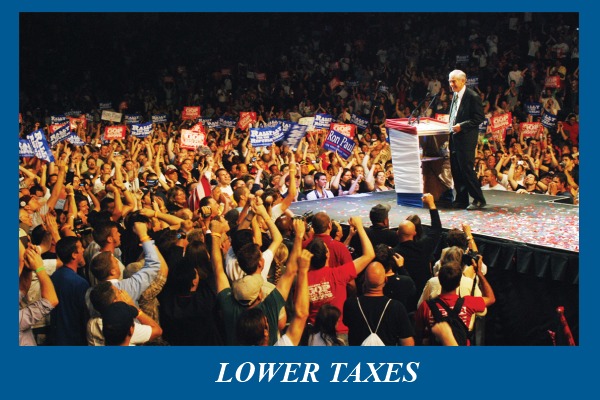
Our national debt is currently over $14 trillion, with the government spending nearly $2 trillion more per year than it collects. The American people should not have to pay for Washington’s reckless and out-of-control appetite for debt.
High taxes stifle innovation, prevent saving, destroy production, crush the middle class and the poor, and discourage investment. Every American is entitled to the fruits of his labor, especially during these tough economic times.
Lowering taxes will leave you more money to take care of yourself and your family, and it will allow businesses greater opportunities to hire new workers, increase current salaries, and expand their companies.
As President, Ron Paul will support a Liberty Amendment to the Constitution to abolish the income and death taxes. And he will be proud to be the one who finally turns off the lights at the IRS for good.
Capital gains taxes, which punish you for success (and interfere with your efforts to hedge against inflation by purchasing gold and silver coins), should also be immediately repealed.
Struggling college students and those working to support their families would be greatly benefited and receive an immediate pay raise by eliminating taxes on tips.
As a congressman, Ron Paul has consistently endorsed legislation to let Americans claim more tax credits and deductions, including on educational costs, alternative energy vehicles, and health care. He also believes it is immoral to tax senior citizens twice by requiring them to include Social Security benefits in their gross income at tax time. A first step to eliminating that requirement would be to repeal the 1993 increase in taxes on Social Security benefits. Then we must abolish that tax entirely.
While a Flat Tax or a Fair Tax would each be a better alternative to the income tax system, Congressman Paul believes we would have to guarantee the 16th Amendment is repealed to avoid having both the income tax and one of these systems as an additional tax.
But there is a better way. Restraining federal spending by enforcing the Constitution’s strict limits on the federal government’s power would help result in a 0% income tax rate for Americans.
The answer to spending and debt is to return to a constitutionally limited government that protects liberty – not one that keeps robbing Peter to pay Paul.
RON PAUL ATTRACTS MORE THAN 2,400 VOTERS TO BOISE RALLY
ENDS PACIFIC NORTHWEST CAMPAIGN TOUR IN THE GEM STATE WITH SENTIMENT THAT WASHINGTON AND IDAHO ARE FERTILE GROUND FOR STRONG CAUCUS SHOWING
BOISE, Idaho – 2012 Republican Presidential candidate Ron Paul ended his Washington-Idaho campaign tour in the Pacific Northwest’s eastern enclave of Boise, a city that greeted him by turning out over 2,400 supporters to his rally. The 12-term Congressman from Texas’ rally took place at 12:30 p.m. MST at CenturyLink Arena, 233 South Capitol Boulevard, Boise, ID 83702.


BOISE, Idaho – 2012 Republican Presidential candidate Ron Paul ended his Washington-Idaho campaign tour in the Pacific Northwest’s eastern enclave of Boise, a city that greeted him by turning out over 2,400 supporters to his rally. The 12-term Congressman from Texas’ rally took place at 12:30 p.m. MST at CenturyLink Arena, 233 South Capitol Boulevard, Boise, ID 83702.
Saturday, February 18, 2012
Fears Iran Helping Al-Qaida for ‘Spectacular’ Attack
© Newsmax. All rights reserved.
© Newsmax. All rights reserved.
Iran has established an “operational relationship” with al-Qaida’s core leadership amid fears the terror organization is planning a spectacular attack against the West, according to a troubling new report.
Sky News reports that the attack could come in retaliation for the killing of Osama bin-Laden last year, or as retaliation for any strike against Iran’s nuclear facilities. And a likely target of the terrorist attack would be the Olympic Games to be held this summer in London.
Iran has been supplying al-Qaida with training in the use of advanced explosives, funding, and a safe haven “as part of a deal first worked out in 2009 which has now led to ‘operational capacity,’” the Sky News website disclosed.
Some Western intelligence agencies have been skeptical of an alliance between Iran and al-Qaida. But last year the Obama administration directly accused Iran of supporting the terrorist group, a report by the intelligence analysis organization LIGNET revealed in August.
At that time, the United States sanctioned six alleged al-Qaida operatives and accused Iran of allowing them to operate in Iran to conduct operations in Afghanistan and Pakistan.
One of those six was a Syrian known as Yasin al-Sura, leader of al-Qaida in Iran, LIGNET reported.
The Obama administration last year offered a $10 million reward for information leading to al-Sura’s whereabouts, and Iran responded by placing him in protective custody, sources told Sky News.
The website reported that top al-Qaida leader Ayman al Zawahiri is now “believed to be planning a ‘classic’ al-Qaida attack, simultaneously on multiple locations.”
Read more on Newsmax.com: Fears Iran Helping Al-Qaida for ‘Spectacular’ Attack Important: Do You Support Pres. Obama's Re-Election? Vote Here Now!
© Newsmax. All rights reserved.
Thursday, February 16, 2012
Chris Rock: "I'll Pay Higher Taxes."
I agree with Chris Rock, they (rich people) can afford higher taxes, because of the fact if they make more than 500,000 dollars a year, paying $185,000 sounds fair. Because when I was working and bringing in $1000 dollars net per week, I would see maybe $750 for a 40 hour week. It makes no sense, having a Country in Debt Trillions of Dollars, but we still believe in not taxing the wealthiest who live here.
Friday, September 9, 2011
America Wants Change but is not Willing to Change
In a moment of clarity, will America take on the challenge it faces or will we watch our dreams crumble from underneath our feet?
Subscribe to:
Posts (Atom)

contact us by email: g.pitsch.85@gmail.com
Submit Domain Name


